Kintsugi

Mend the wallet.
Keep the gold.

Atomic, sweeper-proof wallet rescue using EIP-7702. Open source. Runs locally. No fees, ever.

$ npm install -g @ophelios/kintsugi-cli
Read the docs
The problem

Your keys are leaked. Your wallet is being watched.

A sweeper bot now monitors the compromised address around the clock. The moment any ETH lands there to pay gas for a recovery transaction, the bot front-runs you and drains it in the same block. Tokens, NFTs, and ENS names sit visible but unreachable. Most rescues fail before they start.

Kintsugi removes the gas dependency entirely. The victim wallet never holds ETH at any point. A separate rescuer wallet pays for and submits the recovery in one atomic Type-4 transaction, transferring every selected asset out before the sweeper sees an opening.

The attack, in three beats
  1. You send ETH for gas

    0.01 ETH lands in the compromised wallet.

  2. The sweeper bot grabs it instantly

    Front-runs in the same block. The 0.01 ETH is gone before you blink.

  3. Your rescue transaction reverts

    Out of gas. The transfers never run.

Your assets remain trapped.

Tokens, NFTs, and ENS names sit visible but unreachable. This is where Kintsugi steps in.

The attacker's other trick

When attackers use EIP-7702 against you, we use it back.

After a key compromise, attackers often install their own EIP-7702 delegation on your wallet, pointing it to an auto-drainer contract that triggers on any incoming funds, on any chain. Kintsugi's rescue uses the same primitive to overwrite their delegation, atomically, before our transaction does anything else.

Their move

Install an auto-drainer

  1. 1 Attacker has your private key.
  2. 2 Sign a 7702 authorization pointing your wallet at AutoDrainer.
  3. 3 Submit a Type-4 tx (attacker pays gas, no involvement from you).

Any incoming ETH is auto-stolen in the same block. Across every chain the bot watches.

Our move

Overwrite with the Rescue contract

  1. 1 Sign a new 7702 authorization at the current nonce, pointing to Rescue.
  2. 2 One Type-4 tx: our authorization processes first, overwriting theirs.
  3. 3 Then the same tx calls Rescue.executeBatch on your wallet.

Their drainer never executes. Assets transferred atomically to your safe wallet.

Newer EIP-7702 authorizations at the current nonce always win. That's the spec, not a workaround. Pair with --private-mempool when paranoia is warranted so the attacker can't even see our tx coming.

The recovery gap

They take what's liquid. They leave what's yours.

Drainer bots optimize for fast liquidation. They sweep ETH and the most liquid ERC-20s, ignore everything that takes effort to fence, and move on. The leftovers are often the most personally valuable holdings, but a working sweeper still blocks any normal recovery attempt.

ENS name

vitalik.eth

7-year hold · trapped

Your dot-eth identity, used everywhere for years, is rarely auto-drained — and typically the hardest to move once a sweeper is watching. Kintsugi handles unwrapped 2LDs, wrapped names, and subdomains in a single batch.
Illiquid NFT

BAYC #1234

ERC-721 · trapped

Long-tail collections, art, in-game items, memberships. Bots usually skip ERC-721 and ERC-1155 — resale path's too slow. They stay visible, recoverable by no one.

Low-cap token

$AAVE — gov

vested position · trapped

Reward tokens, governance positions, vested allocations — anything without a deep pool. Drainers ignore them, but you still can't reach them through a wallet the sweeper is gating.

How it works

One transaction. No gas from you. Nothing left behind.

EIP-7702 lets a victim wallet temporarily delegate execution to a battle-tested rescue contract. Combined with EIP-712 batch authorization, every selected asset moves to your safe wallet inside one atomic Type-4 transaction, paid for by a separate rescuer key.

The rescue, in three beats
  1. You sign, locally.

    EIP-7702 authorization + EIP-712 batch of transfers. Keys live in your local Node process only and are never written to disk.

  2. Your rescuer submits one Type-4 tx.

    A separate wallet you control pays the gas. Your authorization processes first, then it calls Rescue.executeBatch.

  3. Every asset at your safe wallet.

    Same block, atomic. The sweeper sees the tx land, finds the wallet empty, and moves on.

  4. Balance never rose above zero.

    No opening for a sweeper, because there was nothing to take. After, optionally clear the delegation with kintsugi revoke.

The agentic way in

In panic? Don't read. Ask your agent.

Kintsugi ships a free agent skill following the agentskills.io spec. Install it once and your favourite AI coding agent learns the three-wallet pattern, the ordering rules, and every gotcha. Then it walks you through a rescue in plain English.

My wallet got drained but I have hostage assets there. Help me rescue them with Kintsugi.

Got it. I'll walk you through this end to end. First, what chain is the compromised wallet on, and do you have a fresh wallet ready to receive the assets?

Mainnet. I have a fresh wallet ready.

Good. Let's start with a read-only inventory of the compromised wallet — that tells us exactly what we'll batch into the rescue. Paste the victim address when you're ready.

Powered by the Kintsugi agent skill

Install the skill once:

$ npx skills add ophelios-studio/skills --skill kintsugi
See what else to ask

Works with:

  • Claude Code
  • Cursor
  • Codex
  • Cline
  • Gemini CLI
Or do it yourself

A UI for panic. A CLI for power.

Same atomic flow under the hood, two surfaces to drive it. The web UI is launched from the CLI as a localhost server. The browser only sees session-bound addresses and signatures. Private keys never leave the local Node process.

127.0.0.1:38080
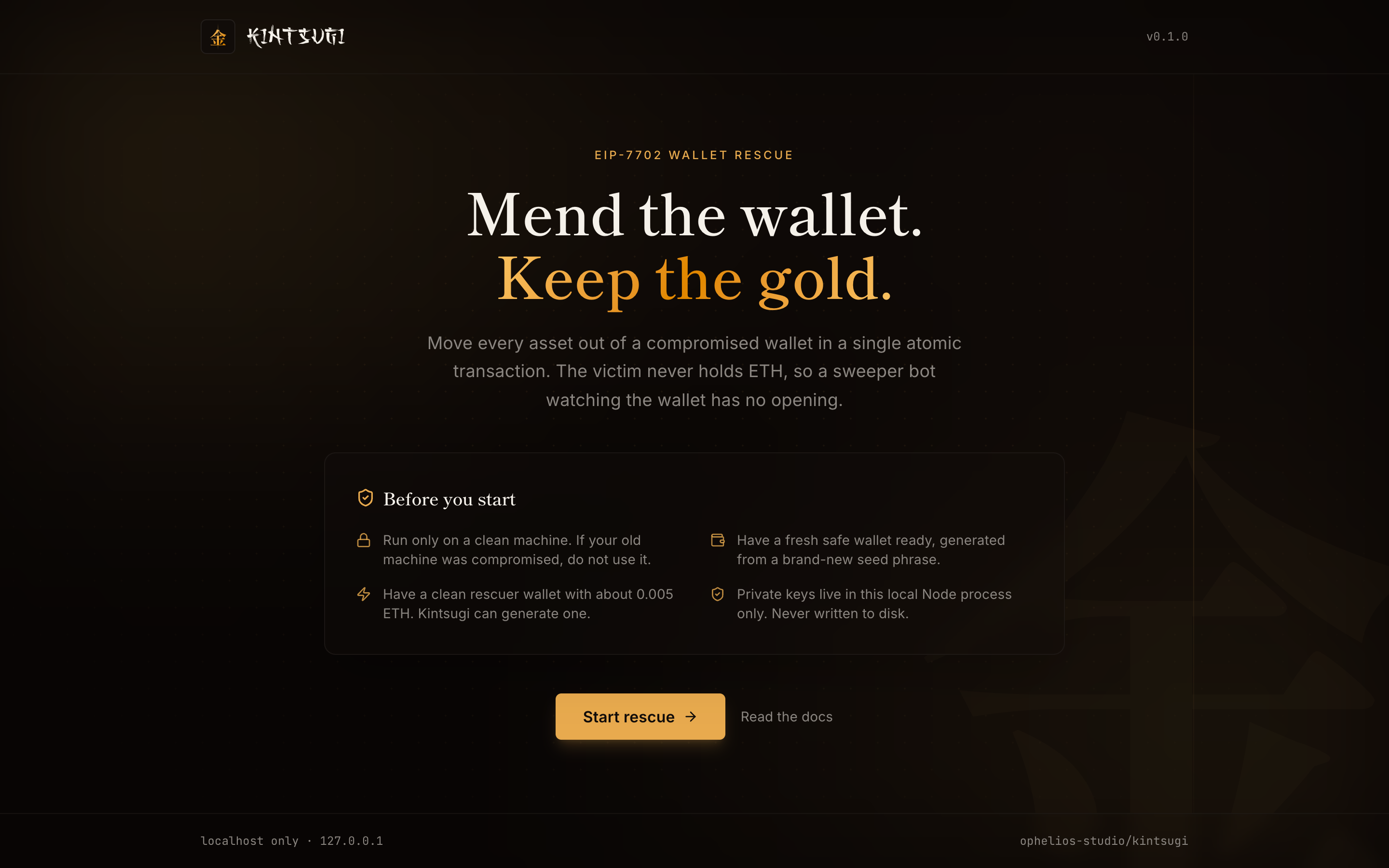
Kintsugi web UI welcome screen with the Kintsugi wordmark and the tagline Mend the wallet, Keep the gold.
The web UI

Guided. Step by step.

  • Pick the network and your RPC.
  • Paste victim, safe, and rescuer wallets.
  • Pick what to rescue, sign, submit.
Walk through the UI →
~ kintsugi rescue
# launch the guided localhost UI
$ kintsugi ui

# ...or do everything in the terminal
$ kintsugi rescue

# inspect a wallet read-only first
$ kintsugi status 0xVictim...

# after rescue, optionally clear delegation
$ kintsugi revoke
The CLI

Headless. Scriptable.

  • One command (kintsugi rescue) walks you through.
  • Read-only inventory with kintsugi status.
  • Pipes well. No browser required.
Read the CLI reference →
Our stance

A wallet rescue tool that charges money in the worst moment of someone's crypto life is a wallet rescue tool taking advantage of panic. We will not do that.

Open source.

MIT-licensed. Public repository. Every line auditable, every contract verified.

No fees.

No SaaS tier. No signup. No telemetry. Pay only your own gas.

No upsell.

No premium features behind a paywall. The whole tool is the whole tool.

Deployments Read the self-audit View source on GitHub
Sepolia
Rescue contract 0x53c1f40ca0a58942f9eb89d7fd445457a8521fd5
NonceTracker 0x717883abfa58fa2bf0f9c2d5a132227253c47963
Mainnet Self-audited, no third-party audit
Rescue contract 0x25b2e6fb74fe4a186f1b3f25b289439fcc80aaca
NonceTracker 0x3dda6ee79963b73cbdba9a4664c880633e7a5087